Giuseppe Zambonini: Loft Utopia
The Zambonini papers offer a striking example of how the archive can radically enhance our understanding of a designer by providing new contexts and new connections.
There’s nothing less utopian and avant-garde than the New York City loft. A symbol of gentrification in Manhattan and Brooklyn, teeming with tech-bros and slumming Wall Street workers, when you see loft construction you can be sure that the artisanal mayonnaise shop won’t be far behind.
However, the loft wasn’t always an entrenched fixture of unchecked economic dispossession. The loft movement in New York began in the 1960s and 1970s as a way for artists to reclaim the under-used and abandoned industrial warehouses of Soho. My recent work processing the papers of architect and interior designer Giuseppe Zambonini reveals that many of the contemporary characteristics of high-end lofts have their origin in experimental and utopian architecture, interior design, and theatre.
Zambonini’s architecture and design career was far from typical. Born in Italy, Zambonini studied architecture at the University of Florence, working with Leonardo Benevolo and Leonardo Ricci. After graduation, he attended the Istituto Universitario di Architettura in Venice, where he studied with the architect Carlo Scarpa, who directed his thesis on the architectural history of Verona.
While at university, Zambonini collaborated with the experimental theatre company Ca’ Foscari, and in 1970 he became artistic and technical director of the Teatro Romanao in Verona, where he produced innovative Brechtian spectacles and Fluxus-style happenings utilizing avant-garde costume and stage design in unconventional performance spaces.
Zambonini brought his engagement with avant-garde performance art and theatre with him when he moved to New York City in 1971 to teach at the New York School of Interior Design. At the same time, he entered private practice as an interior designer specializing in lofts. His lofts were eminently experimental and innovative, retaining the original structure while utilizing open floor plans, exposed brick, columns, partial walls, and skirts capturing the fluidity of stage design.
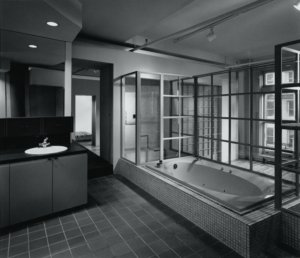
Zambonini’s designs helped transform lofts from rough-and-ready work/life spaces for artists into works of art in their own right. Zambonini’s lofts in Soho and Tribeca won several major awards, were featured in major design and architecture publications, and were the subject of exhibitions at universities and galleries.
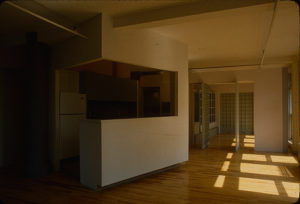
Processing Zambonini’s papers allowed me to put his loft designs in the context not only of his theatrical work, but also in conjunction with his speculative architectural projects. The concept behind The Reliquary came to Zambonini in a dream, and he carried this fantastical element into the sketches, plans, and models he made of the building.
Featuring a domed surface covering a bunker, apparently meant to house a valuable, mystical relic—the drawings and models of the structure depict a hammer, much like the hammer of Thor—the Reliquary is Zambonini’s most realized utopian project. It also sheds new light on his loft design, which have a similar avant-garde utopianism.
The Zambonini papers offer a striking example of how the archive can radically enhance our understanding of a designer by providing new contexts and new connections. By looking to Zambonini’s history in Sixties experimental theatre, and his continued interest in unrealizable speculative architecture, we can see a clear line of descent from these more explicitly avant-garde pursuits to the now-conventional form of the loft. As Sixties and Seventies utopian architecture–such as designs by Zambonini’s Italian colleagues Superstudio–is being rediscovered by everyone from art critics to the tech industry, Zambonini’s work feels more relevant and timely than ever.