Dorothy Payne Whitney Straight Elmhirst
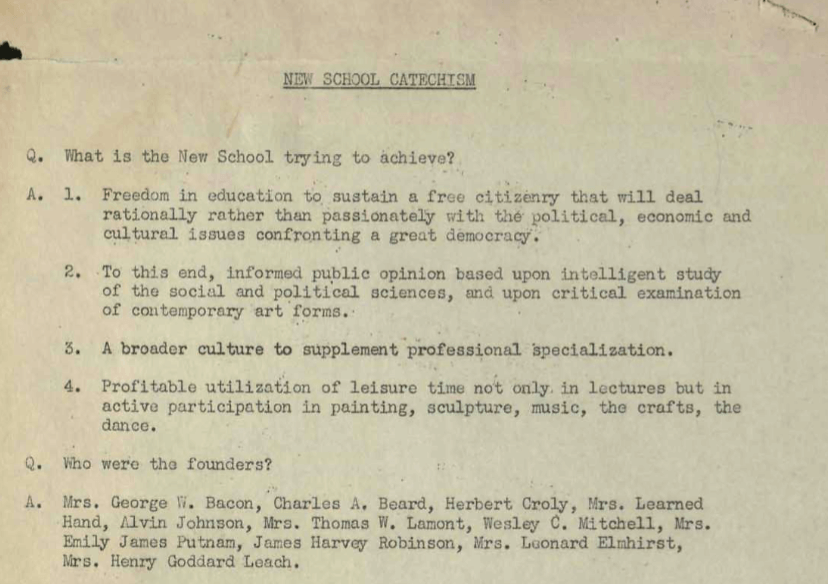
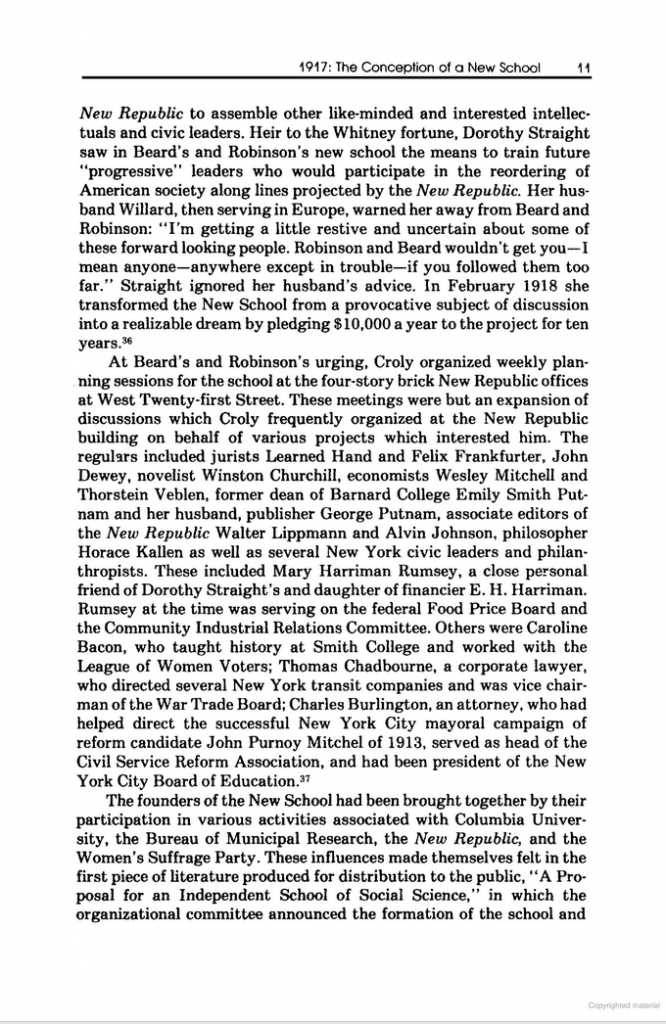
Straight ignored her husband’s advice and she transformed the New School from a provocative subject of discussion into a realizable dream by pledging $10,000 a year to the project for ten years.
Dorothy Payne Whitney was born in 1887, the youngest child of Flora Payne and William C. Whitney. By the age of 17, her mother, stepmother, and her father had all died, leaving Dorothy with an enormous inheritance and a sense of urgency to make her life have meaning. In the years that followed, Dorothy traveled extensively throughout Europe and Asia, feeding her insatiable curiosity, and never forgetting her unique privilege and the responsibility that she felt came with it.
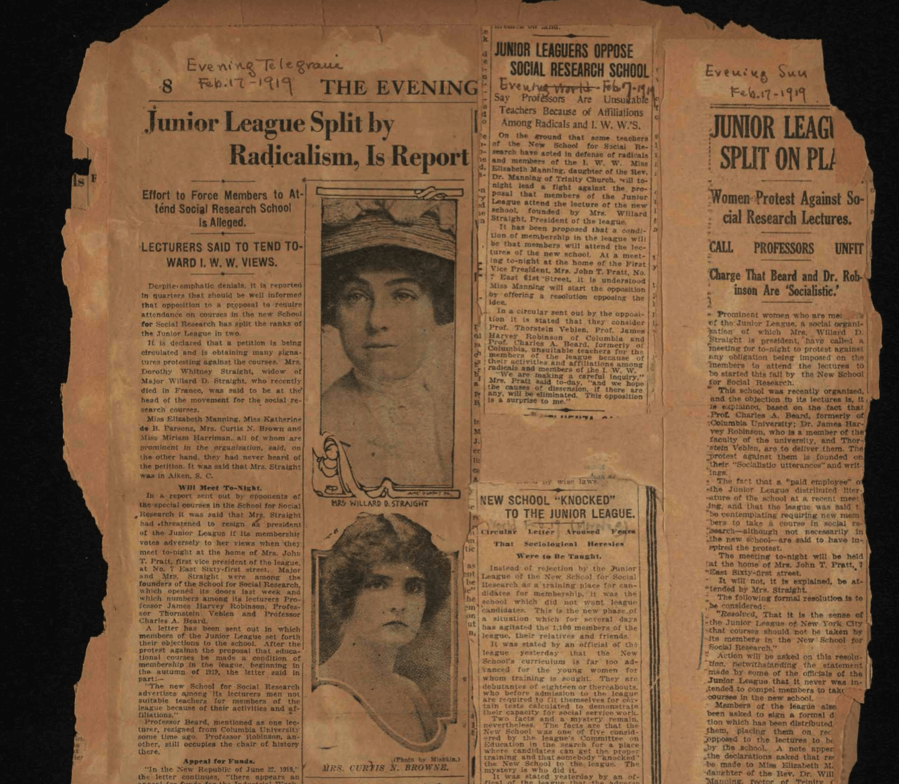
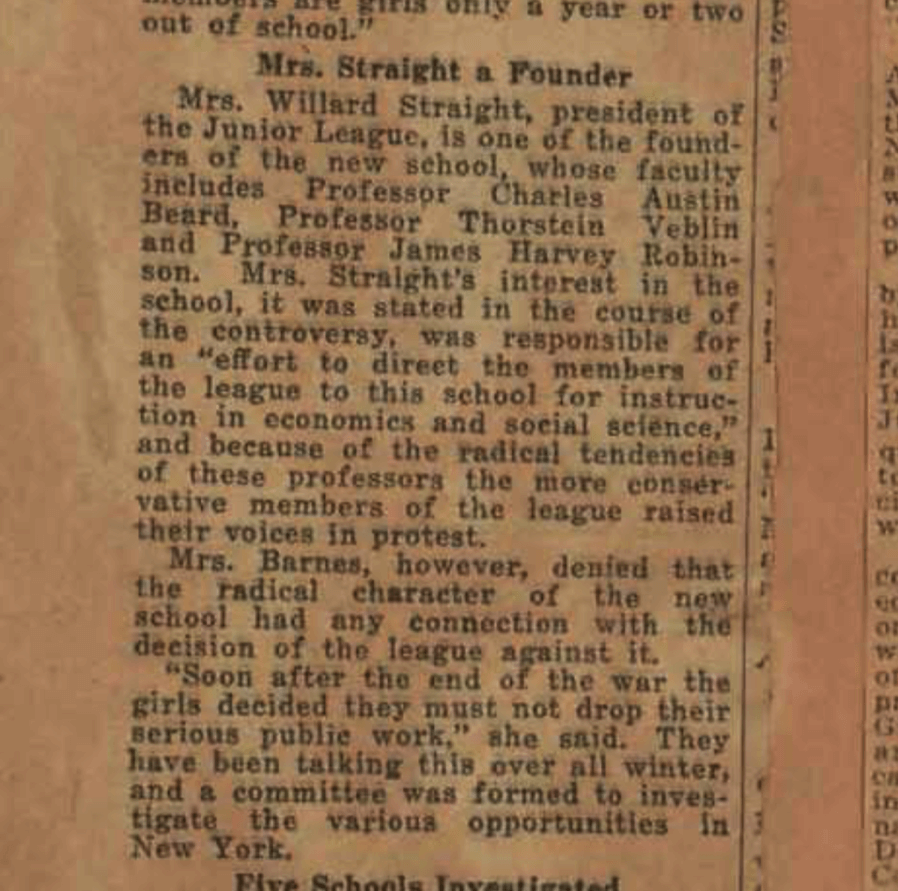
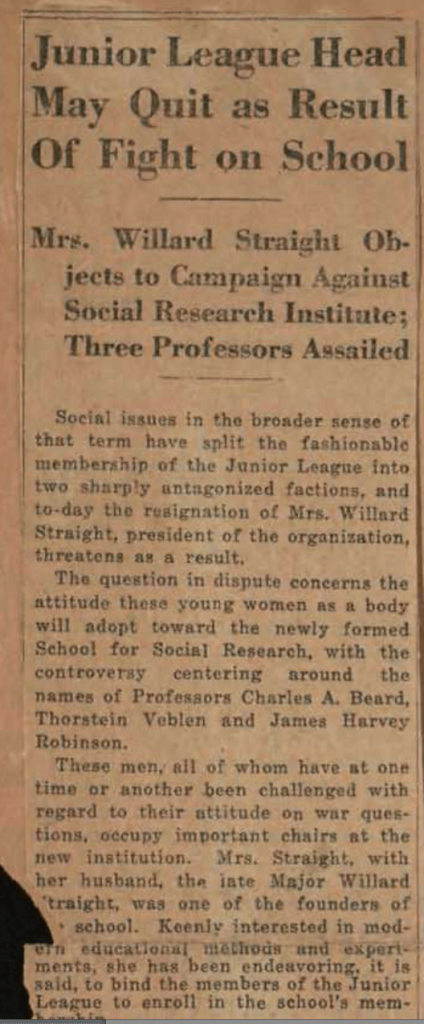
At the age of 20, she became president of the Junior League of New York (1907 – 1909), where she introduced formal training for its members and was also the driving force behind the Junior League Hotel, a new model of cooperative housing for women. She married Willard Straight in 1911, drawn to each other by a shared idealism and a drive to make a difference. After reading and re-reading Herbert Croly’s The Promise of American Life (1909) aloud during their honeymoon, the couple invited Croly for lunch. In the fall of 1914, shortly after the beginning of WWI, the Straights and Croly founded The New Republic, amidst new enthusiasm surrounding Theodore Roosevelt’s launch of the Progressive Party.
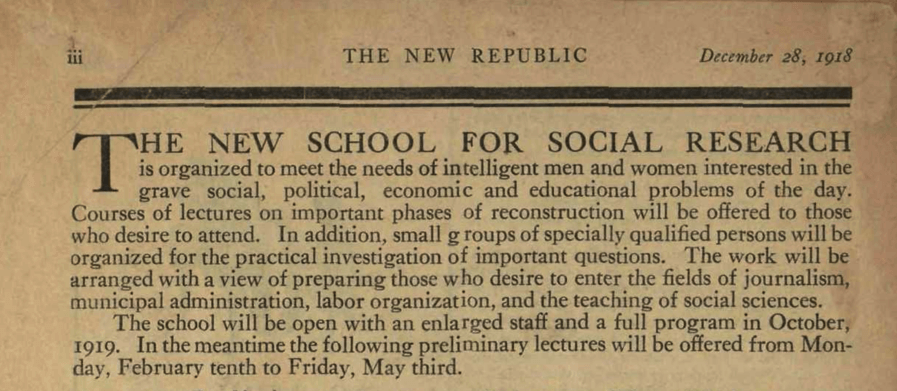
They began inviting like-minded and influential men and women for roundtable discussions at their offices to set an agenda of progressive reform and to determine how this group could change the world for the better. The individuals had been brought together by their participation in various activities associated the Bureau of Municipal Research, the New Republic, the Women’s Suffrage party, and Columbia University. As early as 1916, Croly and Dorothy Straight had spoken with Beard and Robinson about the possibility of establishing an independent social science institute. When the pair resigned from Columbia in 1917, their earlier discussions took on new meaning.
Dorothy’s husband, then serving in Europe, warned her away from them: “I’m getting a little restive and uncertain about some of these forward looking people. Robinson and Beard wouldn’t get you—I mean anyone—anywhere except in trouble—if you followed them too far.” Straight ignored her husband’s advice and she transformed the New School from a provocative subject of discussion into a realizable dream by pledging $10,000 a year to the project for ten years.
Willard died of pneumonia shortly after the war ended (and before the school opened). In his will, he asked that Dorothy make Cornell a “more human place.” She built Willard Straight Hall, a place that is still the heart and soul of Cornell’s campus, and stands as one of the first models of a student union in the U.S.
While working on the Hall, she met her second husband, an Englishman named Leonard Elmhirst, who shared her vision and passion for knowledge and making the world a better place. The couple moved to Totnes, England, where they purchased and restored a medieval property and set about developing Dartington Hall as a lab of experimentation for a “many sided life”. As in The New School’s founding documents (“this is the hour for the experiment”), through her death in 1968, Dorothy never gave up on the educational experiment and progressive ideals that defined her life.
Note: Dorothy appears on The New School founding documents as Mrs. Willard Straight, although her husband died in December 1918, before the official opening. Once she remarried in 1925, her name continues to appear, although now as Mrs. Leonard K. Elmhirst.
Sources: http://connected.ajli.org/2013/03/who-was-dorothy-whitney-straight/ https://www.dartington.org/about/our-history/ Rauchway, Eric: “A Gentlemen’s Club in a Women’s Sphere: How Dorothy Whitney Straight Created the New Republic.” 1999 Journal of Women’s History, Vol. 11 No. 2 http://thenewschoolhistory.org/wp-content/uploads/2013/09/Proposal_for_an_Independent_School_of_Social_Science-1.pdf https://newrepublic.com/article/120193/how-new-republic-was-founded https://nyjl.smugmug.com/Archives/JL-Hotel-1911/
Dorothy Payne Whitney Straight Elmhirst. Source: Junior League Archives.